

Bert West: The father of the Penguin Parade
As a boy of 13, the young Bert West used to go out rabbiting on Summerland on his pushbike.


Phillip Islander AH Bert West, long known as the father of the Phillip Island Penguin Parade, was the first person to realise the tourism potential of the colony of penguins in existence along the Summerland Peninsula.
He founded an attraction back in the 1920s that has grown into a major international drawcard, visited by many millions of travellers over the years.
As well as organising the first sightings back in 1928, and laying the foundation of the penguin parade, he was responsible for their protection for over half a century, his work at the reserve in the early years ensuring the penguin colony’s survival and preservation.
As a boy of 13, the young Bert West used to go out rabbiting on Summerland on his pushbike.
And he could hear the noise of a particular bird in a burrow which intrigued him.
He went home and looked up a book and realised that the birds he had seen were fairy penguins.
He decided at that young age that when he was older, he would bring people into the area, and show them the penguins.
And in 1928, when the road out to Summerland was first opened, he did just that.
With two other Berts, Bert Denham and Albert Watchorn, he organised hire cars to take visitors out to see the penguins , thus developing the penguin parade concept.
The popularity of such visits grew to the point that a bus was soon needed, and of course what followed is history.
By 1931, Bert West had been appointed honorary wildlife officer for Phillip Island.
For the protection of the penguins, he had taken on the responsibility of overseeing the nightly viewing, and addressing problems he had identified, making suggestions for crowd control and the provision of amenities.
There was no electricity in those days.
Drivers who took people out to Summerland took long torches to shine on the marching penguins, and trampling of burrows was a worry.
Bert ensured that safeguards were quickly introduced to protect the penguins against crowds; and worked towards fire prevention.
He also introduced the nightly commentary and initiated a research program.
He wrote to the Fisheries and Wildlife Department to ask for assistance and worked hard to ensure that this area was officially proclaimed a penguin wildlife reserve.
In effect, Bert West became the first conservation officer for this part of the world and the creatures in it.
In the 1930s the local Spencer Jackson family, seeing the need, donated 10 acres (four hectares) of their land adjoining Summerland Beach to the Phillip Island Shire Council, to provide a permanent and protected home for the penguin colony.
(The Shire of Phillip Island reserved additional land shortly after for this purpose and did so again in 1955.)
Visitor numbers soared in the 1940s when the first bridge to connect the mainland to Phillip Island was erected.
Tourists began flocking over it, and the penguin parade was a highlight of their visits.
As lifelong protector of the penguins, Bert West recognised early the problems relating to increased visitation that would arise, and was concerned about people treading on nesting areas, due to there only being rough tracks through the Marrum Grass to see them.
In the early 1950s he started charging an entry fee to see the penguins.
At that time it was one shilling per adult and children were free.
His intention was to put the money back into the area by paying for rope barriers, and to eventually build concrete stands and toilets.
In all of this, he received no payment – he was a volunteer and devoted every night of the year to this work.
On one particular night he had waited all night for the penguins to come in and not one turned up.
He feared that they must have moved on.
But the next day he spoke with local fishermen who informed him that it was a quirk of nature as even the barracuda had gone elsewhere in search of food.
He was relieved when the penguins returned the next evening.
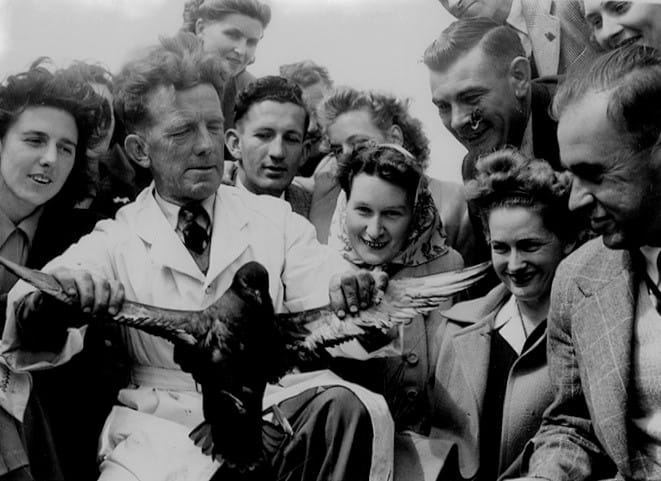
In time, he had a commentary box built so he could talk to the visitors each night and inform them of the wonders of the penguins.
In doing so, he established a tradition that remains very much a part of the Penguin Parade today.
More safeguards
Administration of the penguin parade was with the Shire of Phillip Island, and Bert was officially appointed as Penguin Parade Manager in 1961, a paid position he held until 1971.
During that time, he continued to ensure that the protective safeguards in relation to overcrowding and dune damage were in place, and ensured the breeding colony was fenced to prevent attacks by foxes, cats and dogs.
He bought fire-fighting equipment and sought and developed a fire ban program following the disastrous breeding area fires of 1967, in which penguins and mutton birds perished.
On one occasion he called surfers out of the water at Summerland over a loudspeaker, to help him fight a fire in the dunes that had started.
Recognising the importance of interpretation and information, Bert introduced commentary.
He initiated a comprehensive research program, when in 1960 he approached the CSIRO for bands to mark the penguins to learn more about their lifestyle, in order to be able to protect them.
The penguin study and research program he initiated continues today and is one of the longest continuous population studies of an Australian bird species.
Another major legacy was his foresight in establishing a hospital for injured penguins.
Bert retired in 1974 at the age of 74 years, the year he was awarded a BEM in the Australia Day honours list for his services to penguin preservation and tourism.
Penguin protection continues
By the late 1970s, the Phillip Island Shire had closed road on the Summerland Peninsula to vehicles between dusk and dawn, to stop the road carnage of penguins that was occurring after dark from unrestricted vehicle traffic.
The Shire also recognised at this point the need to conduct research into penguins, to halt a decline in numbers, and set up a Scientific Advisory Committee for the protection of penguins.
The first research biologist Peter Dann (still there) worked under the direction of this scientific advisory committee. Professor Mike Cullen was chair.
At about the same time, the state government began making overtures to take over control of the island’s natural assets.
In 1984, the state government took over.
The Phillip Island Shire Council, in one of its last administrative acts, spent $200,000 in borrowings, for the purchase of further land at Summerland, to increase the penguin area.
A new Committee appointed by the Minister for Conservation Forests and Lands was established to manage the Parade.
The following year, in 1985, then Premier John Cain and Minister for Conservation Forests and Land Joan Kirner unveiled a further plan, which was the buy back of all the homes on the Summerland Estate, in order to protect the penguin colony.
The Department of Conservation and Environment then controlled the Penguin Reserve until 1996, when the Phillip Island Nature Park was formed.
This involved the creation of the approximately 2000 hectare Phillip Island Nature Park by Marie Tehan, State Minister for Land and Conservation in the Kennett Government, which saw the amalgamation of the Penguin Reserve, Nobbies, Seal Rocks, Cape Woolamai, Rhyll Inlet, Koala Conservation Centre, and other coastal foreshore areas, placed under one management authority.
As the architect of PINP, Marie Tehan decreed that the money generated from the Penguin Parade would not go back into state general revenue, as had been the case up until that time, but would be directed toward conservation of all of the island’s wildlife, reserves and coastal foreshore.
This important move, along with the buyback of Summerland has underpinned the success of PINP in its mission to protect and preserve the penguins, along with all of the island’s flora and fauna.
In 1991, the boardwalk connecting the new education and interpretative centre at the penguin reserve was named the Bert West Boardwalk in recognition of the enormous contribution made by him over five decades.
The penguin study and research program Bert West initiated continues, and is one of the longest continuous population studies of an Australian bird species.
The Phillip Island Nature Park is today recognised as one of the best eco-tourism facilities in Australia, balancing scientific research and conservation with visitor education and unique wildlife experiences.
Bert West’s story and place in history is now firmly entrenched at his beloved Penguin Parade with the boardwalk connecting the interpretative and education centre being named in his honour.
In accordance with his wishes, his ashes were scattered under the commentary box at Summerlands so that they would be carried back into the sea when the penguins paraded by.
He passed away at the age of 92 in 1996.


