

Bird flu is here. What happens now?
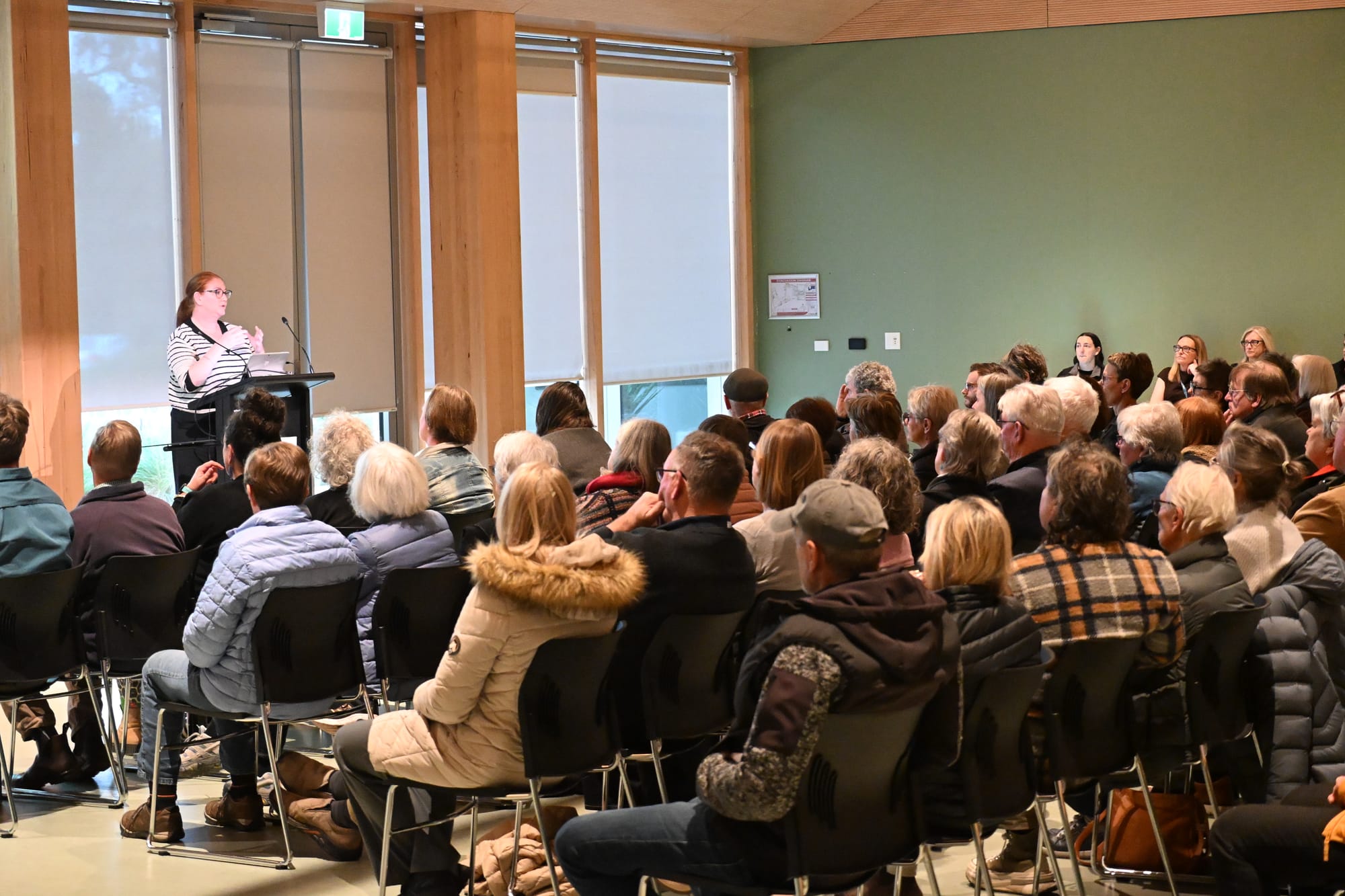
Around 100 community members attended the public H5N1 bird flu meeting on Friday, with many commenting it was a valuable and informative experience.


Authorities do not expect to eradicate H5N1 bird flu, and told a community forum at Berninneit on Friday night that the deadly, fast-spreading virus is something Australians would have to learn to live with.
Department of Energy, Environment and Climate Action (DEECA)'s Eve Graham said although the mutating-strain of bird flu was first detected around six years ago, earlier this year was the first time it had reached Australian shores.
"What we don't know is how this virus will actually operate on our Australian wildlife," she said.
"We also don't know what the mortality rate is going to be for our particular species, because we haven't had it before.
"At the moment it really is a watch and learn (situation)."
Eve Graham is the director of wildlife and landscape protection at DEECA, and spoke alongside: Agriculture Victoria's state controller for the H5N1 response Dr Julie Simons; Phillip Island Nature Parks CEO Catherine Basterfield; and director of the Gippsland Region Public Health Unit Dr Alyce Wilson.
Around 100 community members attended the session, with many commenting that it was an informative and refreshing opportunity to hear directly from those leading Victoria's bird flu response.
Here are your questions, answered by the experts:
How is the bird flu situation being monitored?
Multiple speakers stressed the role individuals play in continuing to report sick or dead birds to authorities.
Ms Graham said bird flu was first detected in Victoria through community reporting, which remains "one of our greatest tools".
"What we're particularly looking for is when people are seeing groups of five or more birds that might be sick or unwell, or if it's a single species like a seal or penguin or something significant," she said.
Ms Graham said before Victoria's first confirmed case authorities were averaging around 10 community reports per week, but are now receiving close to 200 reports per day.
"That is a really important tool for us, because it is helping us understand how the virus is moving," she said.
Authorities have also been utilising a Firebird 300 helicopter with enhanced surveillance capabilities alongside crews deployed on-the-ground.
What is the risk to human health?
Dr Alyce Wilson said the "important message" was that bird flu did not pose a significant threat to human health.
"Avian influenza is different to human influenza, and for that reason the risk to humans is quite low," she said.
"Birds and other animals have receptors that avian influenza binds to very easily - and hence it's easily spread - whereas in humans, the avian influenza doesn't bind as easily to our receptors, and that's why the risk is lower."
Dr Wilson said the humans who could be at risk are those who have close or prolonged contact with sick or dead birds.
"If there is any contact with sick or dead birds, wash your hands thoroughly and make an appointment with your GP; call ahead to let them know you've had contact with a sick bird and they'll give you appropriate advice in consultation with the public health unit," she said.
What happens to the carcasses of dead birds?
Dr Simons said the national position is to - where possible - leave birds and wildlife where they are to decompose naturally.
"However, in public areas we are working with land managers to know if there is a public health amenity issue, and that amenity includes tourists," she said.
"Particularly in urban areas and areas where there is high visitation, land managers may need to dispose of that wildlife."
Dr Simons said although leaving carcasses in situ meant there was a risk to scavenger birds, the virus was already spreading through wild bird populations and disturbing flocks could cause further harm.
What happens if a bird dies in my backyard?
If disposal is necessary on your land, Agriculture Victoria warns to not touch dead birds with your bare hands.
Wear a face mask, glasses, long sleeves, gloves and shoes you can clean, and put the dead bird into two plastic bags using tongs or a shovel.
Ensure the bags are tied and place the bird in your general (red) waste bin, before washing yourself thoroughly and all clothing and equipment that came into contact with the bird.
What is the risk to commercial poultry?
Dr Simons said although there had been currently no bird flu detections in Australian poultry, either on farms or at homes, the spread of the virus to chickens was likely inevitable and the results would be devastating.
Chickens are particularly susceptible to the virus, with most birds succumbing to sudden death in a matter of hours.
With the current H5N1 spread predominantly tracked across the coast, Dr Simons said the Chief Veterinary Officer has applied a housing requirement for all coastal shires which is currently in place until September 18.
"That requirement is for people who have 50 or more birds to take active efforts to confine their poultry," Dr Simons said.
The ACCC has also granted an exemption for farmers who market their chickens as 'free range' to continue using the label due to "exceptional circumstances".
Dr Simons also urged farmers to download biosecurity plans for poultry farms, available on the Agriculture Victoria website.
What about backyard chickens?
For poultry-keepers, Dr Simons said "one of the key things is to bring your feed in so that you're not sharing your feed or water with the wild birds".
"Separate your poultry from wildlife and wildlife droppings and feathers," she said.
"Clean water frequently, and if you've been on the beach don't wear your beach shoes near your poultry ... Have clean shoes when you're with your poultry and think about visitors too.
"Make sure your shed is clean, and wash your hands before going in to help pick up the eggs."
What is a large-scale mass mortality event?
Ms Graham said while Victoria was yet to experience a large-scale mass mortality event, DEECA was yet to specifically define what it would constitute.
"We're talking about it at the moment in the context of where we need to support clean-ups, so that's going to be situationally specific," she said.
"From a biodiversity perspective, we're just going to have to monitor and see."
The country's first mass-mortality event was declared earlier this month when 49 dead and 35 sick greater crested terns were found by an aerial surveillance team in South Australia.
"In that event, they felt it was a mass mortality because it was very unusual for suddenly around 50 terns within one flock to die," Dr Simons said.
What is the risk to marsupials?
Ms Graham said authorities had completed a risk assessment of marsupials, and considered the animals to be low risk.
"In saying that ... it depends, because we haven't had this virus here in Australia and obviously we're keeping a close eye on it," she said.
"But from what we've seen around how it's affected animals overseas, we are predicting that it will be low risk."
Should the San Remo pelican feeding be cancelled?
Dr Simons said authorities were working to balance preventative measures with risk minimisation, but were not going to restrict activities such as pelican feeding.
"Pelicans do flock naturally, and from what we are seeing that spread is going to happen anyway through the natural population," she said.
"Ecological and community practices are still really important things to do and be a part of."
A council officer also said they had been liaising with staff at the San Remo Fisherman's Co-op.
What is the risk to pets?
Dr Simons said while there had not been a detection of bird flu in domesticated Australian animals to date, the virus did pose a threat to household pets, including cats and dogs.
Although pets overseas have died from the bird flu, according to advice from the Federal Government it "is infrequent in cats and dogs".
"When it occurs, there is usually a history of dogs or cats being exposed to sick or dead birds, other animals infected with avian influenza virus, consumption of raw pet food or unpasteurised (raw) milk," the government states.
Can I walk my dog on the beach?
Dr Simons said there were no bird-flu related restrictions that meant dogs could not be walked on beaches.
"Yes, your dogs can be on the beach, but we're really asking that you take action to look after your pets," she said.
"If your dog is anything like my dog, it will love to hunt out a dead bird and have a good roll in it ... and dogs are at risk.
"So keep your dogs on a lead and make sure that they are not running off and coming back with a dead bird in its mouth."
READ MORE:
Not to be sneezed at: factor in the spread


