Much Ado about MotoGP: uproar on the island
Stephen Fullarton was appointed chairman of the Phillip Island council’s newly-formed Grand Prix liaison committee group when the event first came to the island.


Before the roar of the island, there was uproar on the island.
Not everyone was in favour of the international race breaching its largely unknown shores.
As reported in the Phillip Island and San Remo Advertiser in February 1989, hundreds gathered at a community forum to protest against the impending Grand Prix being held here.
“They did not want it in any way, shape or form,” the Advertiser reported.
A Cowes doctor – who concluded his speech with a ‘Power to the People’ salute and an appeal to stand up and be counted – was among those preaching against the race.
“A crowd of 100,000 people with access to alcohol spells trouble,” he was reported as saying.
“The Grand Prix is too big for Phillip Island, and will change its character forever.”
History has proven the doctor was right about one thing, and one out of three almost ain’t bad.
Stephen Fullarton, who was appointed chairman of the Phillip Island council’s newly-formed Grand Prix liaison committee group, alongside Victorian Police Chief Inspector Brendan Bannon, had been charged with handling a range of off track logistics to facilitate the crowds expected to attend the event.
Stephen took to the stage in support of the race at the forum, and attempted to assuage concern raised in town hall prophecies of unbridled bikies and untold mayhem.
“There was a fear of pillaging and rampaging from bikies … wild, doom and gloom predictions that just never happened,” he recalled in an interview with the Advertiser last week.
“But they didn’t want to hear the measures we were putting in place to facilitate the event, or what we had to say. They literally howled me down.”
One island councillor even suggested at the forum that local schools be closed on the Friday, for the safety and protection of the island’s children.
Then Phillip Island shire president Stan Gates, speaking after the forum, described the meeting as “a fiasco, and the denial of the opportunity to present the facts by those in support to those who were concerned”.
Grand Prix fever hits
Vocal, local opponents of the Grand Prix that night included Anne Davie – convenor of the protest meeting but who is now compiling a history of MotoGP on the island for Bass Coast Shire Council.
However, Stephen’s recollection was that the vast majority of naysayers were holidaymakers from Melbourne.
The local designer still bristles when he talks about it.
“It was the first time I realised the power off-island residents could have and use on Phillip Island,” Stephen said.
“It shocked me to see the influence that a small group like that could exercise.”
Nevertheless, planning proceeded, and the arrival of an international event was instantly recognised by its supporters as having the potential to change the face and fortune of the island forever.
“All of those fears were allayed very quickly when people realised the type of crowds that were here,” Stephen said.
“The whole main street was jam packed … and we didn’t have any of the dramas which people were worried about.”
Estimates vary that between 90,000 and 100,000 people descended on the island to watch that first Australian International Grand Prix event.
Traffic was at a standstill when it was over, with Stephen recalling a sea of around 20,000 people marching from the track at Ventnor into Cowes to celebrate.
The Advertiser recorded the historic occasion with the headline: “Grand Prix fever hit Cowes with a vengeance last Thursday”.
“In what could be described as an amazing turn of events, residents and local people took bikers into their hearts,” the Advertiser reported.
Many letters to the editor congratulated and commended Phillip Island’s council and the council’s GP liaison committee for the work put in to facilitating off track crowds and event entertainment over the weekend.
After the controversy and criticisms aired over the previous months, one letter writer, Sue Brown of Cowes, said: “It (the running of the GP) has truly restored my faith in human nature. It has put Phillip Island on the map, and we can now receive world recognition which will boost trade in tourism and business,” she wrote.
Even the staunch hive of off-island cynics were begrudgingly receptive.
A member of “the Concerned Citizens’ Association, speaking from his Melbourne home early in the week, said that his impressions were that the event seemed to have gone off successfully,” the Advertiser reported.
“However, he believes … there are still serious issues to be addressed.”
Not so easy come easy go
The euphoria that followed the first GP’s overwhelming success of the first GP was short-lived.
And little over a year later, with the event set to be snatched from the island into NSW, the cause for uproar had turned full circle.
In September 1989, the Advertiser reported: “From public uncertainty prior to the event in 1989, many local people now recognise the (economic) value of the Australian Motorcycle Grand Prix, and regret that it has apparently been lost.”
However, it continued, “Phillip Island is not prepared to sit back on its laurels and allow the Grand Prix to go to Sydney without a fight.”
Before the days of pro-forma online documents, the Advertiser printed coupons for people to register their support for keeping the race on Phillip Island.
Copies of the “local rag” sold out, and the coupons were photocopied to meet demand. But the deal had been done and time was up.
One month after more than 1000 coupons had been collected, the Advertiser reported that the event was lost.
“Mr Rod Wallbridge, Chairman of the Barfield Pty Ltd … set out to end speculation surrounding the alternating of the Grand Prix between Victoria and New South Wales,” the Advertiser reported in October 1990.
“We have no doubt that the Australian motorcycle Grand Prix will be held at Eastern Creek in 1991,” Mr Wallbridge was reported as saying.
The sad end of an era
Stephen is one of many islanders who feel a keen sense of loss – and deja vu – over this year’s MotoGP.
Along with being one of the race’s earliest local advocates, and chair of the liaison committee that planned off track facilitation for the thousands of spectators who flocked here annually, in his professional capacity he designed every building on the track.
Stephen also ran the Lukey Heights and Siberia race day carparks for decades, and over the years has spoken to thousands of motorcycling enthusiasts.
“There are three facets to the enjoyment of trip: it’s the ride here and back, the event itself, and the atmosphere on the island,” he said.
“The journey, the event and the town. That’s what will live with them for the rest of their lives.”
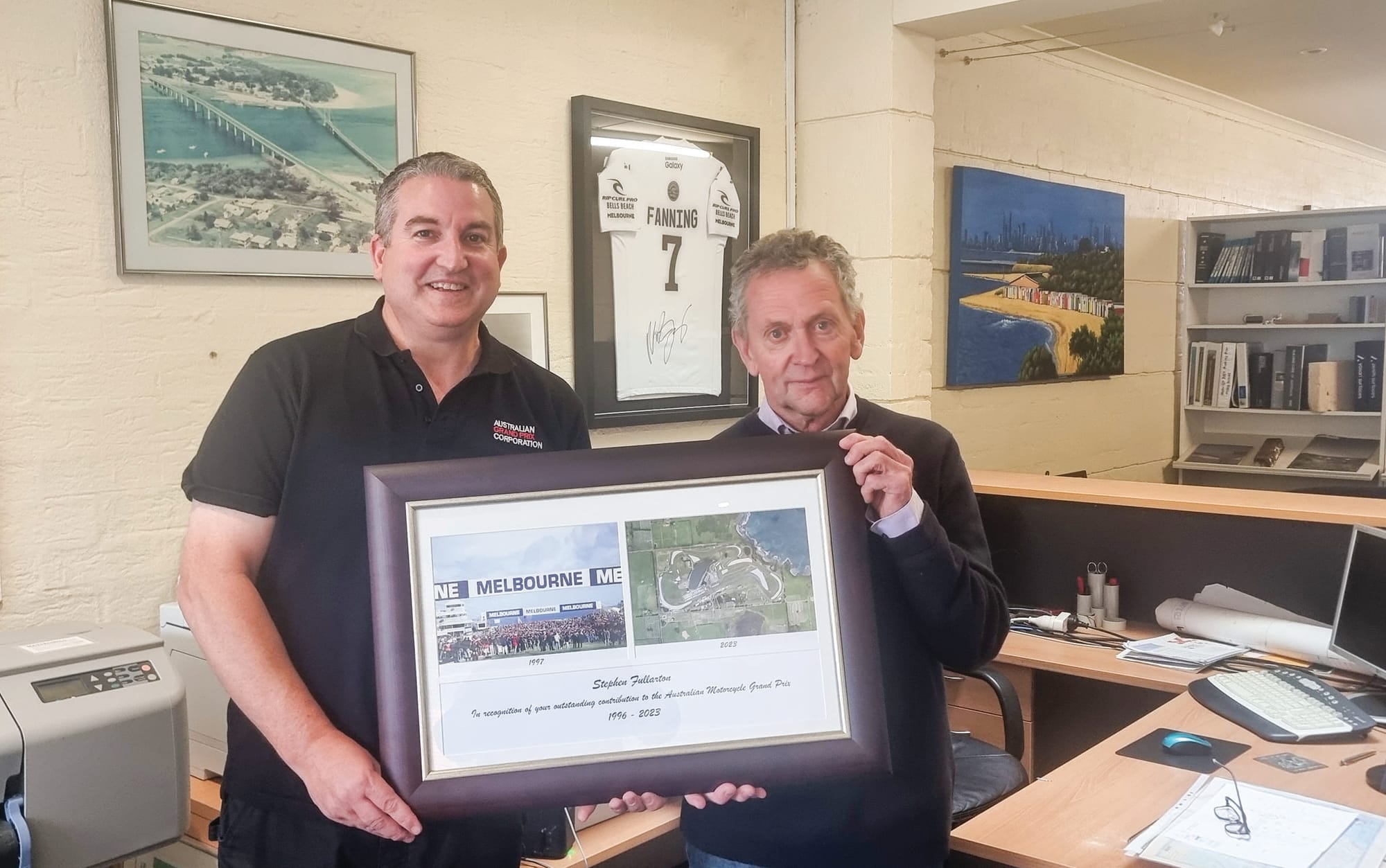
Late last year, Stephen was recognised by the Australian Grand Prix Corporation for his “outstanding contribution” to the success of the Australian Motorcycle Grand Prix.
Arguably, apart from the late Fergus Cameron – who he credits as the genesis of a vision that changed an entire region forever – there is no local more credited for helping to facilitate the successful staging of the Grand Prix on Phillip Island than Stephen.
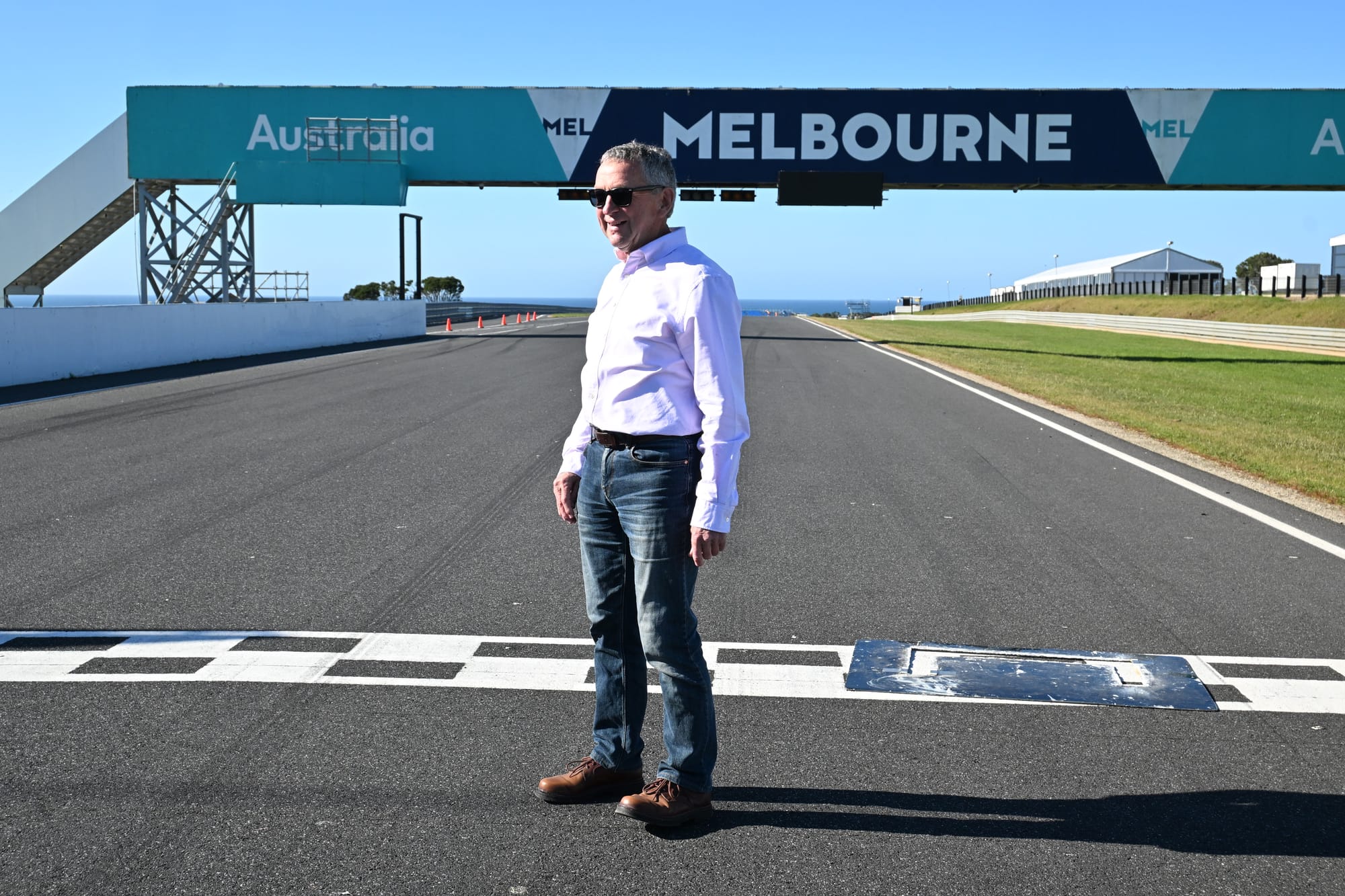
As he stepped out onto the track last week ahead of the last MotoGP there was a pensive air about the islander.
“The memory of what we presented here will be held for generations by the motorcycle family,” he said.
“It’s the end of such a massive era for Phillip Island.”