

Silverleaves inundation prevented
Rock wall extended in the seventies and Inundation prevented


Twenty years down the track from the work carried out in the late 1950’s to build a wall when the public asset of Lover’s Walk and Stradbroke Avenue and the private properties behind them were threatened with inundation, it was decided by the Phillip Island Shire Council that it was necessary to extend the existing sea wall barricade . . . . from Coghlan Road to Ellen Road.
This work took place between 1975 and 1980.
More efficient machinery was available then, than was available in the 1950’s when the Lover’s Walk rampart was built by Donald Dixon, John Reid, Arthur Niven and Steve O’Callaghan.
And it was Donald Dixon’s brother Laurie Dixon who was involved in the work this time.
Laurie worked at the Phillip Island quarry, as did John Reid, and it was they who carted rocks from the quarry into Cowes for placement this time.
Laurie recalls that the section of wall he was involved in was extended one section at a time.
He operated a large front end loader machine, which meant that the operation of building a rockwall was not as labour intensive as it had been for his older brother twenty years earlier.
John Reid brought rock in from the quarry in a tip truck, dumping it in various locations near the foreshore, and Laurie, using his front end loader, scooped the rocks up with his machine, and strategically placed the rocks to form a sea wall.
As was the case in the 1950’s when the two earlier walls were built, a Public Works Department officer was present.
“He had to be with me all the time,” said Laurie.
Unlike the 1950’s, the rocks were unloaded in a single operation from a height, directly onto the foreshore, from a track along the beach.
Construction of the wall was certainly a lot easier and required far less manpower than the 1950’s operation had, said Laurie, who placed almost triple the weight of rock than was used on the earlier Lovers Walk/Stradbroke Avenue section of the rampart.
Five thousand metres, in fact, over a five year period.
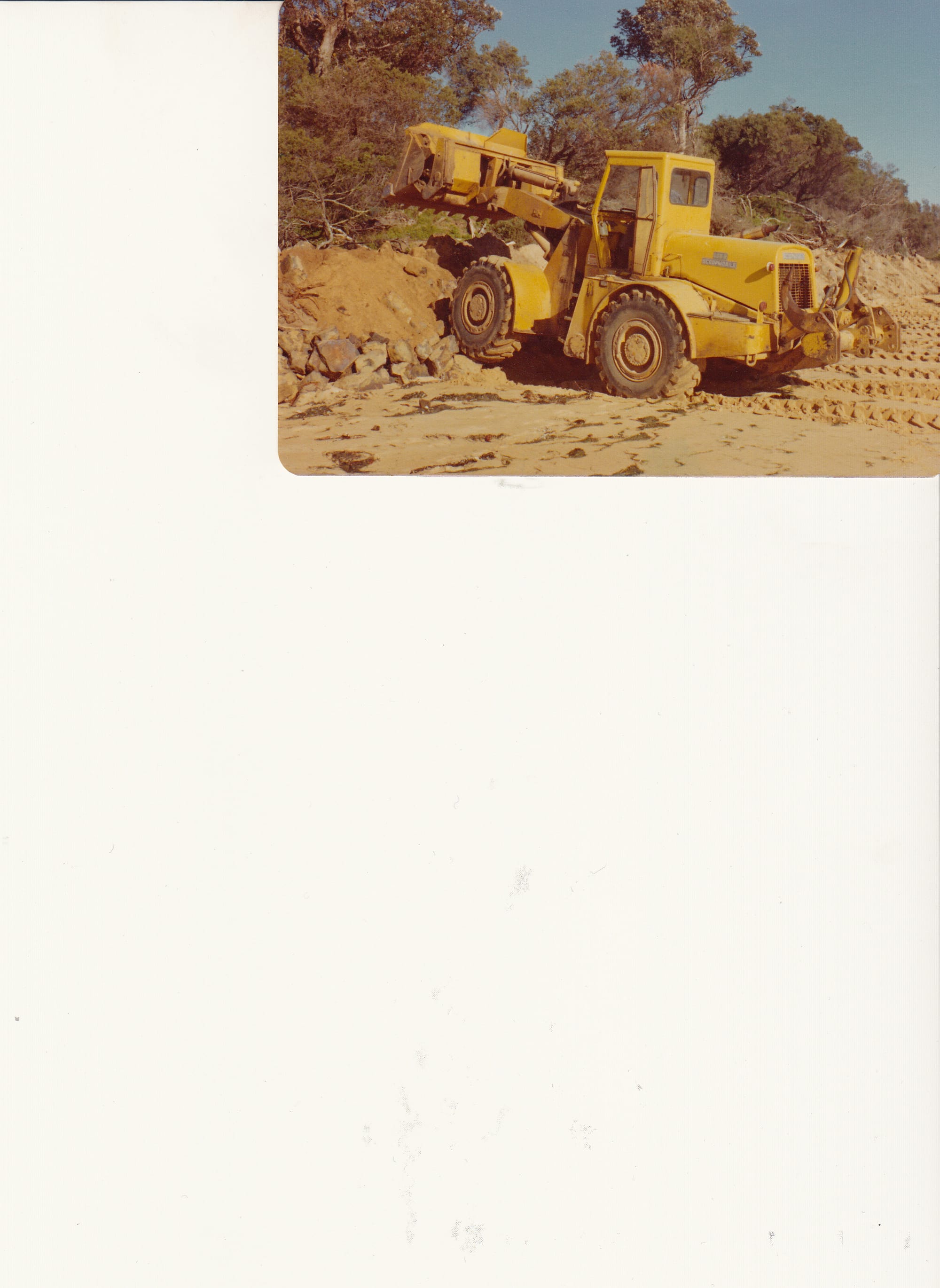
“We had a track up along the beach and built the wall that way, dropping a load of rocks from the front end loader bucket, he recalled.
“We worked our way along the beach.”
John Reid, who worked at the quarry for 35 years, recalled in a 2014 interview with the Advertiser bringing eight or nine loads of rock into Cowes per day on this job.
John described the state of the Silverleaves beach front between Coghlan Road and Ellen Road as “a real mess when we started.”
He believed the work carried out building the rock wall from Coghlan Road to Ellen Road in front of Silverleaves, most certainly saved the area from coastal inundation.
“It was all washing away,” he recalled in the interview with the Advertiser.
“The foreshore would have gone by now if action was not taken. Just as well it was.”
John Reid carted every rock that makes up this wall.
The work was completed in three separate stages.
“The work stopped when they spent the money they had budgeted.
“Then they would get another grant, and do another stage,” John Reid and Laurie Dixon commented.
“That is how that section of wall was built.”
.


