Cerberus land sale leads to calls for bay protection
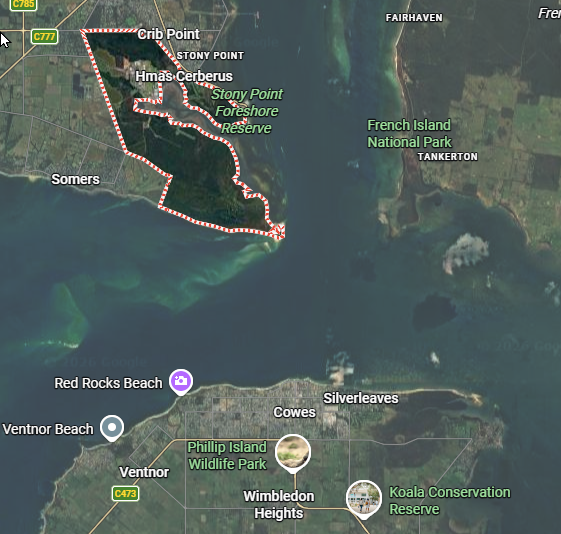
Conservationists have called for a large chunk of HMAS Cerberus - opposite Phillip Island - to be protected, as part of Western Port's internationally-significant environment.


Conservationists have called for a large chunk of HMAS Cerberus - opposite Phillip Island - to be protected, as part of Western Port's internationally-significant environment.
The Federal Government has announced 1164 hectares of the Royal Australian Navy (RAN) base is for sale, with the land fronting Western Port's UNESCO-protected Ramsar wetlands.
The sale of the land has also renewed concerns about the legacy of "forever chemicals" on the RAN base, which continue to pose a low risk for human health.
A Western Port Biosphere spokesperson last week said the natural value of the RAN bushland would "struggle to compete with the interests of those seeking to cash in on prime real estate".
"This means that within the Western Port Biosphere, the meagre 12 per cent of land allocated as protected terrestrial native habitat is under siege," the spokesperson said.
"For a UNESCO-declared area of significant biodiversity, we're falling well short of Australia's international undertaking to set 30 per cent of our land for protection."
The spokesperson said they were seeking support from philanthropic trusts to buy the land, but "in the absence of cash to buy it ourselves, influence and advocacy for our native species is the best tool at our disposal".
"Nothing will stop the sale of these assets but, maybe we could insist there are strings attached to protect areas of significant natural value.
"Those strings may impact the development potential and therefore the price of land and we will face substantial resistance to setting conditions protecting areas of environmental significance.
"The starting point for preserving important tracts of natural habitat is awareness of their significance."
The spokesperson said the land sale was "symptomatic of the increased pressure being placed on the Western Port Biosphere Reserve's most precious places".
The biosphere includes Phillip Island and was recognised by UNESCO 20 years ago and is one of only five biospheres in Australia.
PFAS
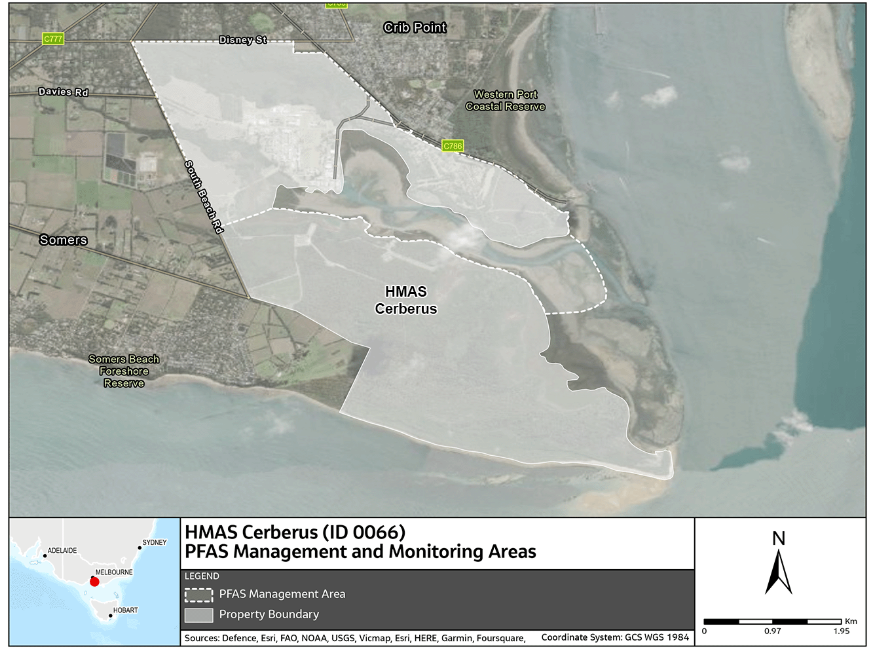
HMAS Cerberus has more than 1500 hectares of land, with 1164 hectares marked for divestment, including vacant land and a golf course.
The base at Crib Point faces Hanns Inlet, between Sandy Point and Stony Point, was bought in 1911 and commissioned in 1920.
It trains recruits from all three branches of the Australian Defence Force and has about 1800 people at any time.
The Western Port Biosphere spokesperson said most environmental investigations of the site in recent years focused on analysing the penetration of PFAS chemicals (poly-fluoroalkyl substance) used in fire-fighting foam during training.
PFAS contamination has been investigated and managed by the Department of Defence since 2017, with remediation in 2023 involving the removal of about 32,000 tonnes of contaminated soil.
It is not possible to remove all PFAS from the environment, with the investigation finding the contamination via surface and groundwater had a low exposure risk to human health.
The investigation found while there was evidence of PFAS accumulation in fish caught in Hanns Inlet - which leads from the base to the bay - there was "no exposure risk to potential human consumers, noting that access to these waters for fishing purposes is strictly prohibited".
Defence continues to monitor PFAS on and around HMAS Cerberus through sampling of surface water and groundwater, holding community engagement sessions to provide updates.
PFAS harm human health by accumulating in the body and environment, potentially causing increased risk of cancers, reduced kidney function, immune system suppression, developmental issues in children and reproductive hormone changes.