

Island roads to slow under speed zone review
Roads on Phillip Island would have a maximum speed limit of 80km/hr under a proposal by Regional Roads Victoria.


Roads on Phillip Island would have a maximum speed limit of 80km/hr under a proposal by Regional Roads Victoria.
The proposal would also see some roads that are currently zoned 80km/hr drop to 60km/hr, including Cowes Rhyll Road, Coghlan Road, Ventnor Beach and Grossard Point roads.
Last year a coalition of Phillip Island community groups called for a speed reduction on island roads to protect wildlife.
The Phillip Island Medical and Health Action Group, Island Voice, Rhyll Community Association and a Cowes citizen scientist – who has been researching roadkill for two years – called for a reduction to 80km/hr on the five island roads that currently have a 100km/hr limit: Back Beach Road, Ventnor Road, Rhyll-Newhaven Road, Berrys Beach Road and a section of Ventnor Beach Road.
The groups said four dirt roads were also unsigned and therefore seen as 100km zones: Pyramid Rock, Harbison, McFees and Watts roads. In addition they were concerned two sealed roads on the island – Gap Road and Smiths Beach Road, between the Phillip Island Road and Back Beach Road – have no speed limit signs and therefore by default – by law – became 100km/hr roads.
An Advertiser poll last year, run for nearly two weeks, asked whether motorists supported a reduction in speed to 80km/hr on the roads that currently have 100km/hr limit. Results were split, with 49 per cent (514 votes) in support and 51 per cent (522 votes) against.
“Wildlife roadkill is prevalent on roads all over the island,” citizen scientist Ron Day told the Advertiser last year.
“Do we have to wait for a human tragedy to occur on our roads before Regional Roads Victoria will accept the need for lower speeds?”
Last year Ventnor residents also created a petition requesting Bass Coast Shire and RRV “act as a matter of urgency to cut speed limits and improve signage in residential precincts of Ventnor”.
“We are particularly concerned about safety along Ventnor Beach Road and its interfaces with Lyall Street and Harris Road, specifically the numerous access points to walking trails and nature reserves, public playgrounds and toilets, the pony club precinct, car parks and dog beaches,” the petition stated.
Organisers of the petition told the Advertiser they were concerned there were no footpaths on Ventnor Beach Road, which is shared by foot traffic and bikes, alongside cars that often travel faster than 80km.
Several years ago the Phillip Island Integrated Transport Study (PIITS) recommended 80kph speed limits throughout Phillip Island.
RRV proposal
Transport Department Gippsland director Sara Rhodes-Ward last week told the Advertiser that “focused on ensuring safer roads for Phillip Island”, RRV had reviewed all existing rural 100km/h speed limits on sealed arterial and municipal roads, with the shire.
“The review has resulted in a proposal to introduce a maximum speed limit of 80km/h across the island’s sealed road network to improve safety for the local community, visitors, and Phillip Island’s unique wildlife,” Ms Rhodes said, adding they had worked for six years with stakeholders including businesses, Destination Phillip Island, residents’ association and the transport reference group.
“We will continue to inform the community as we finalise our proposal in the coming months.”
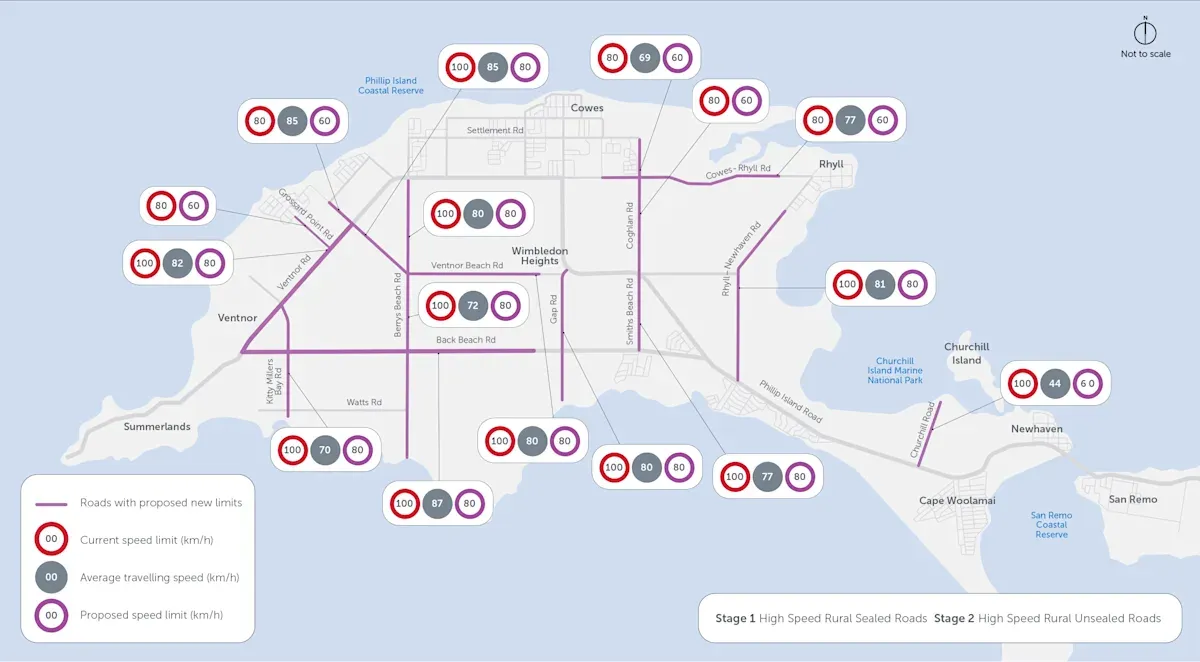
According to a confidential map received by the Advertiser (see above), RRV has monitored average road speeds across the island.
On Berrys Beach Road monitoring showed drivers averaged 80km/hr, which has instigated the recommendation of an 80km limit. On Ventnor Beach Road the average speed was 85km/hr, leading to a recommended drop to 60. Yet on the Cowes-Rhyll Road, motorists drove at an average 77km/hr, with RRV recommending it become a 60 zone.
Criticism, support
Former councillor Stephen Fullarton criticised aspects of the proposed speed reductions.
“I can accept 100km-80km but to drop key roads to 60 – such as the Cowes-Rhyll Road and Coghlan Road – is unacceptable,” he said.
“I fully acknowledge wildlife issues, but wildlife problems are dusk to dawn, not daytime.
“If you’re a tradie crawling round in 60km zones, it will be difficult. I urge the community to give their input.”
Island Voice acting secretary Peter McMahon last week welcomed RRV’s proposal but said some recommendations didn’t “go far enough”.
“Some areas where wildlife crosses should have been looked at differently,” Mr McMahon said.
He said Island Voice’s final position would be decided at their monthly meeting at the end of April, adding he urged all stakeholders to be a united front and support the changes, rather than pushing for “individual interests”.
Ron Day – who daily for two years has surveyed roadkill on the Cowes-Rhyll Road, last year told the Advertiser a “common comment” from drivers opposed to reduced speed limits on the island was that “an animal will be just as dead if hit at 60k/h as it would at 100k/h”.
“What they fail to acknowledge is a driver’s ability, due to additional reaction time, to safely avoid an animal impact at the lower speed,” he said.
“The five roads on which we are wanting to implement speed reductions have unsealed gravel verges and do not have solid, or wire rope barriers to prevent collisions with roadside trees and vegetation. There is also the real possibility of a vehicle roll over should it run off the verge and into the deep culverts or drains.
“The inconvenience to motorists (of a 20km/hr speed reduction) is less than one minute of extra travel time on any of the five roads in question.”
For unlimited access to full editions, breaking new alerts, sport and historical files, click here to subscribe. Free 7 day trial on all new subscriptions.


